
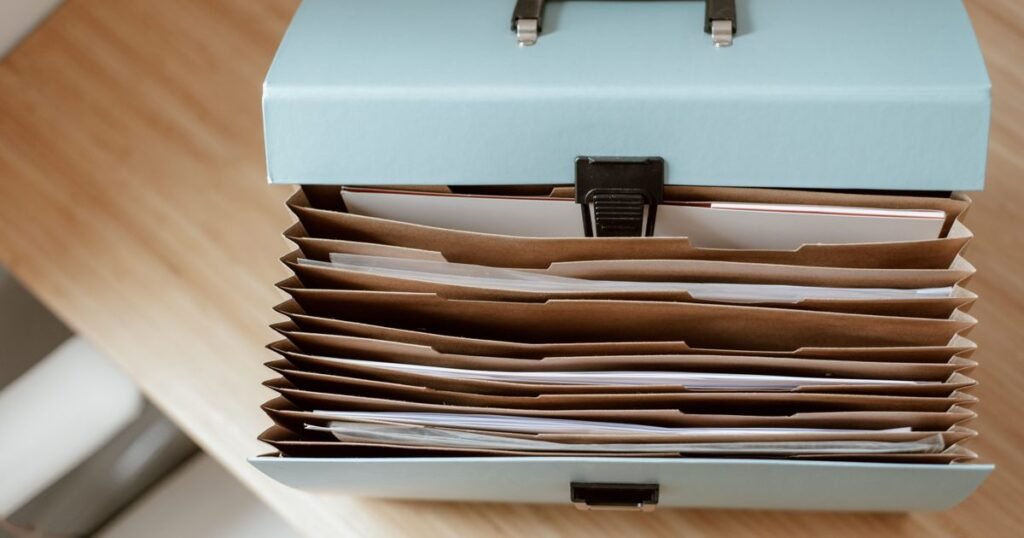
The claim adjuster asked for the policy number, and the policy was in the file cabinet, and the file cabinet was in the part of the house that no longer existed. Everything after that took four times longer than it should have — not because the claim was disputed, but because every step started with proving who she was and what she had owned. The fire took one afternoon. Reconstructing the paperwork took most of a year.
The four groups
Sort by what each paper lets you do, not by what kind of document it is.
1. Proving who you are. Everything else gets gated behind this.
- Driver’s licence or state ID, both sides
- Passport — the photo page
- Social Security card, or just the number recorded securely
- Birth certificates for everyone in the household
- Marriage certificate, divorce decree, custody orders
- Naturalization or permanent residency documents
- Military discharge papers (DD-214) — needed for VA benefits and often for burial
2. Proving what you own and what is covered.
- Every insurance policy: home, renters, auto, life, health, umbrella — the declarations page, which has the policy number and limits, not the whole booklet
- Deed or mortgage statement
- Vehicle titles and registration
- Recent statement from each bank, retirement and investment account — you need the institution and account number, not the balance
- A video walkthrough of the house, narrated. More on this below.
3. Medical.
- Insurance cards, front and back
- A list of current medications with dosages, and the prescribing doctor
- Allergies, especially drug allergies
- Immunization records for children
- Any implanted device cards — pacemaker, stent
4. Legal and end-of-life.
- Will, and where the signed original lives
- Power of attorney — financial and medical are separate documents
- Advance directive or living will
- Trust documents
- Contact details for your attorney and accountant
The home inventory video
This is the highest-value fifteen minutes on the entire list, and almost nobody does it.
Walk through the house with your phone recording, narrating as you go. Open closets. Open drawers. Open the garage. Say what things are and roughly when you bought them — “that’s the dishwasher, Bosch, 2023”. Film serial number plates on appliances. Pan slowly across bookshelves and the contents of cupboards.
The reason is specific: after a total loss, the insurer asks you to list what you owned. From memory. People reliably list about half, and the other half is simply not paid. Fifteen minutes of video is worth thousands of dollars and prevents a second grief.
Do it again whenever something significant changes.
Where the copies go
Three places, because any single place can fail in the exact way you are planning for.
- Encrypted in the cloud. A folder in Google Drive, iCloud or Dropbox, inside an encrypted archive. The free 7-Zip can create an AES-encrypted
.7zwith a password; so can most PDF tools. Do not put unencrypted scans of your Social Security card in a cloud folder. - A USB drive in the go-bag. Encrypted the same way. Twelve dollars.
- Paper, somewhere else. A relative’s house, a safe deposit box, a trusted neighbour. The copies that matter most on paper: identity documents and insurance declaration pages.
And the fourth, which is not a copy: a fireproof document bag for the true originals — birth certificates, passports, the signed will, titles. Thirty dollars, rated to around 1,000°F, and it goes in the closet you can reach on the way out.
The password problem
An encrypted archive is useless if the password lives only in your head and you are the person in the hospital.
Use a password manager and give emergency access to one person you trust. Both 1Password and Bitwarden have this built in: a nominated person can request access, you get a waiting period to decline, and if you do not respond they get in. That is the mechanism that works when you cannot be asked.
The low-tech version: the password written on a card, sealed in an envelope, at a relative’s house.
One evening, in this order
- Pull everything from group 1 and photograph each page flat, in good light. Your phone’s Notes or Files app has a scanner that produces a proper PDF — use it rather than a photo.
- Find the declarations page of each insurance policy. One page each.
- Walk the house with the camera running.
- Put it all in one folder. Encrypt it.
- Upload it, copy it to a USB drive, print the identity and insurance pages.
- Write the date on the folder name —
Documents-2026-11. Next year you will know whether it is current. - Set a calendar reminder for twelve months out.
Two hours, once. The version of you that needs this will not have two hours.