It came back on sometime in the night and you have no idea when. The clock on the microwave is flashing, which tells you nothing useful. Now you are standing in front of an open fridge at seven in the morning making a three-hundred-dollar decision about groceries, and the only instrument you have is your nose — which is, it turns out, the single worst tool for this particular job. The appliance knows exactly what happened. It simply has no way of telling you, unless you gave it one in advance.
The rule is a number, which is why you need to measure it
Forget the hours you have read. The actual line is this:
Any perishable food held above 40°F for more than 2 hours goes in the trash. Above 90°F — a hot kitchen with no air conditioning — that window shrinks to 1 hour.
Everything else is an estimate standing in for that measurement. The usual figures — four hours in a closed fridge, 48 in a full freezer, 24 in a half-empty one — are guesses at how long the contents stay under 40°F. They are what you use when you have no number. Having the number is better, and it costs almost nothing.
The four-dollar version
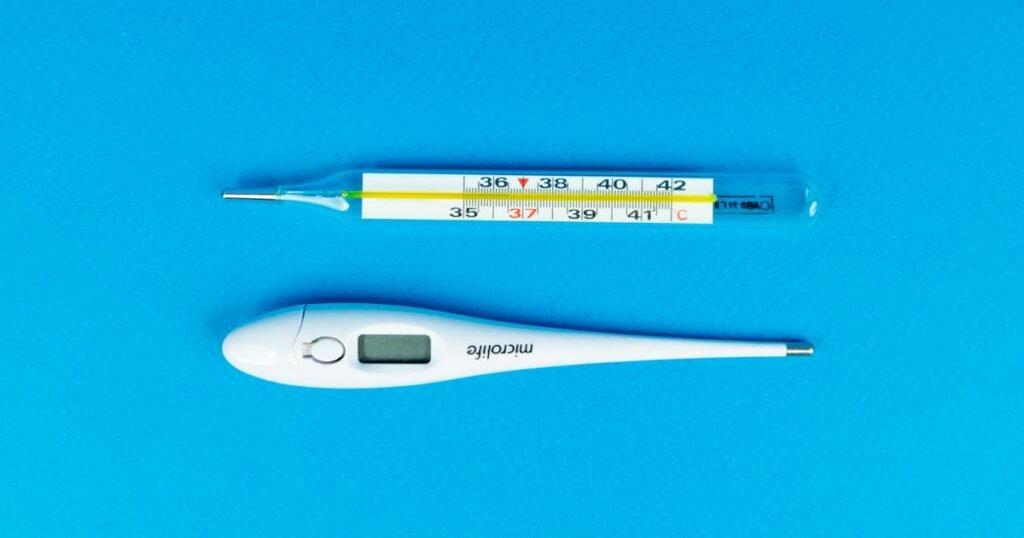
An appliance thermometer in the fridge and another in the freezer. That is it. Most home refrigerators run several degrees warmer than the dial claims, and nobody discovers this until something goes wrong.
Better: a min/max thermometer, around twelve dollars. It records the highest temperature reached since you last reset it. You come home, read the maximum, and you know whether the contents crossed 40°F while you were out — which is precisely the question, and the one a plain thermometer cannot answer.
The coin trick, for the freezer
The analog classic, and it works better than it has any right to.
Freeze a cup of water solid. Set a coin on top of the ice. Leave it in the freezer. If you come home and the coin is still on top, the freezer never thawed. If the coin is at the bottom, everything melted and refroze while you were away — and the food is a different decision entirely.
It costs nothing and it is the only way to know what happened during a multi-day absence without a powered device.
The version that calls you
If the house is empty often, or you have a chest freezer worth several hundred dollars of meat, the sensors are now cheap enough to be obvious.
- Wireless fridge and freezer thermometers, roughly 25 to 40 dollars. A probe inside, a hub on Wi-Fi, an alert to your phone when the temperature crosses a threshold you set. The important feature is the alert, not the live reading — you want to be told, not to remember to look.
- Temperature data loggers, around 20 dollars. No Wi-Fi: they record continuously and you read the history over Bluetooth when you get home. This gives you the full curve — how high it got, and for how long — which is the exact input the safety rule needs.
- A smart plug with power-loss notification, around 15 dollars. It does not measure temperature at all; it tells you the moment the power went out and the moment it returned. Combined with the 4-hour rule, that is often enough on its own.
One caveat worth knowing: a Wi-Fi sensor stops reporting when the power goes out, because the router goes with it. The notification you get is “sensor offline”, which is still the information you need — it timestamps the start of the outage. For the rest, a logger that keeps recording on its own battery is the more reliable instrument.
Reading the result
With a number in hand, the decision is mechanical.
Fridge went above 40°F for more than two hours — throw out: meat, poultry, fish and shellfish raw or cooked; lunch meat, hot dogs, bacon; milk, cream, yogurt, sour cream, soft cheese; eggs out of the shell and anything containing them; leftovers, casseroles, soups, cooked pasta and rice; cut fruit and vegetables and bagged salad; opened mayonnaise and cream-based dressings; opened plant milks.
Keep: hard cheeses, butter, whole uncut fruit and vegetables, opened jam, peanut butter, mustard, ketchup, olives, pickles, bread, fruit juice, vinegar-based dressings.
Freezer: if the food still has ice crystals in the middle of the package, or is still at or below 40°F, it is safe to refreeze. Quality drops — refrozen meat is wetter, berries turn to mush — but it is safe. Open a package in the centre of the load, not at the edge. Ice cream that fully melted is the exception: discard it even if it refroze.
Setting it up before the next one
- Thermometer in the fridge and the freezer today. Confirm the fridge is at or below 40°F and the freezer at 0°F. A good share of households discover a problem at this step alone.
- Freeze water in containers to fill the empty space. A full freezer holds cold roughly twice as long, and you get drinking water as it melts.
- Set up the coin cup. Thirty seconds, no batteries, works forever.
- If the house is ever empty for days, add a logger or an alerting sensor. Thirty dollars against a freezer full of food is not a close call.
- Know where to get ice. Dry ice is the serious option — 25 pounds holds a full freezer for 3 to 4 days. Gloves, and never in a sealed container.
And when it comes back on: read the freezer thermometer first, then go through the fridge in one pass with the trash bag already open, working from the list rather than item by item. Deciding food by food is how the chicken gets kept because it “seems fine”.