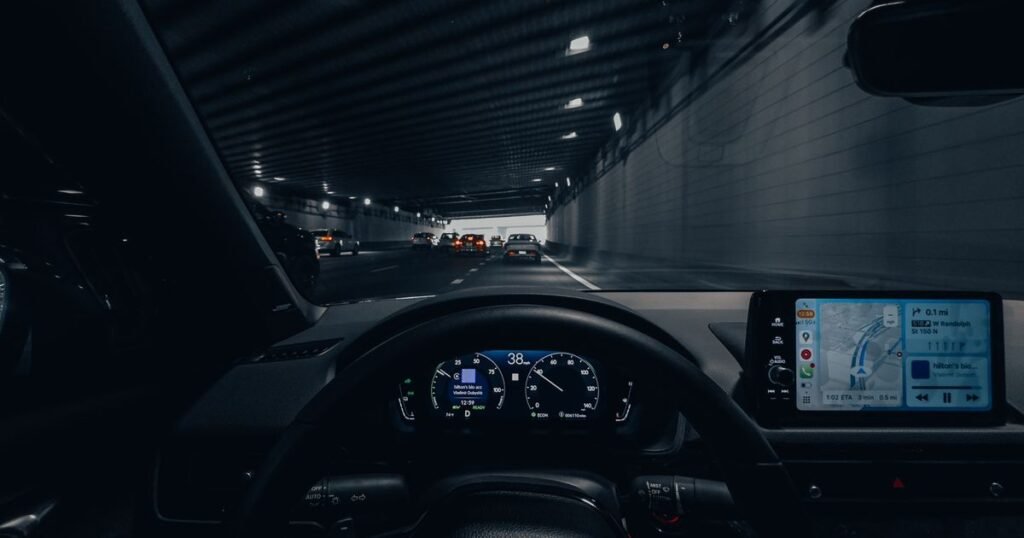
A light came on somewhere past the exit for the airport, orange and shaped like something mechanical, and the entire rest of the drive was spent wondering whether the car was about to do something dramatic. It was not. It was the tyre pressure sensor reacting to the cold snap. But the uncertainty was real, and it came from the fact that nobody is ever taught the one thing that makes the dashboard legible: the colour means more than the symbol.
The colour code
- Red — stop safely now. Something is failing or unsafe.
- Amber or yellow — something needs attention soon. Keep driving, make an appointment.
- Green or blue — a system is simply on. Headlights, cruise control, high beams. Not a warning at all.
That alone resolves most of the panic. If it is yellow, you have time.
Red: pull over
Oil pressure — the little oil can, or a genie’s lamp. This is the most urgent light on the car. It does not mean you are low on oil; it means oil is not circulating under pressure. Metal is running on metal. Pull over, switch off immediately. Check the dipstick. If oil is low, topping up may fix it. If the level is fine and the light stays on, the car gets towed. Driving on this light is how an engine is destroyed in minutes.
Temperature — a thermometer in waves, or the word TEMP. The engine is overheating. Pull over and switch off. Do not open the radiator cap on a hot engine — the coolant is above boiling and under pressure and it will come out at you. Wait at least thirty minutes. Turning the heater on full blast while you find somewhere to stop genuinely helps, because it pulls heat out of the engine into the cabin.
Battery or charging — a rectangle with + and −. The alternator has stopped charging. The car is now running on the battery, which gives you maybe twenty minutes. Turn off the radio, air conditioning and anything else drawing power, and drive directly somewhere useful. Do not switch the engine off until you are where you want to be, because it will not start again.
Brake — a circle with ! inside, or BRAKE. Check the handbrake is fully down first; that is the common cause. If it is, you may be low on brake fluid or have a hydraulic fault. Test the pedal gently at low speed. Soft or long travel means do not drive.
Steering — a steering wheel with !. Power assistance has failed. The car still steers, but it takes real force, especially at parking speeds. Get off the road.
Amber: this month, not this minute
Check engine, solid — the outline of an engine block. This covers hundreds of possible faults, most of them minor. The single most common cause is a loose fuel cap, so take thirty seconds and tighten it until it clicks; the light may clear after a few drives. Otherwise, a parts store will read the code for free and tell you what it is.
Check engine, flashing — this is different and it is serious. Flashing means an active misfire dumping unburnt fuel into the exhaust, which destroys the catalytic converter — a part that costs well over a thousand dollars. Reduce speed and get it looked at today. Treat flashing as red.
Tyre pressure — a horseshoe shape with ! in the middle. Usually just cold weather; air contracts and the sensor notices. Check all four with a gauge and inflate to the number on the sticker inside the driver’s door — not the number on the tyre sidewall, which is the maximum, not the target. If it returns within a day, you have a slow puncture.
ABS — the letters in a circle. Normal braking still works completely. What you have lost is anti-lock assistance in an emergency stop. Safe to drive, book it in.
Traction or stability control — a car with squiggly lines. If it flashes, the system is working right now and you are losing grip; ease off. If it stays on solid, the system has faulted or has been switched off.
Airbag — a figure with a circle in front. The airbag will likely not deploy in a crash. Nothing happens day to day, which is why people ignore it for years. Get it fixed.
The ones that are not warnings at all
Green and blue simply mean a system is active: headlights on, high beams on, cruise control engaged, turn signal. The blue high-beam symbol causes more confusion than any other, because people see a bright blue light and assume it is bad. It means your brights are on and you are dazzling oncoming traffic.
What to keep in the car
- A tyre pressure gauge. Five dollars, and it turns the most common warning light into a thirty-second job.
- A quart of the correct oil, with the grade printed on the cap.
- An OBD-II code reader. Twenty dollars, plugs in under the dash, and tells you in plain language what the check engine light means. The one tool that converts a vague worry into a decision.
- The owner’s manual, actually in the glovebox. Every car’s symbols differ slightly and the manual has the complete chart.
And the habit worth building: when a light appears, note what you were doing — accelerating, braking, after refuelling, on a cold morning. That sentence is often more useful to a mechanic than the code itself.